Key takeaways
If you’re searching for the answer to studying at Europe’s best universities, you’re in the right place. This blog is your one and only guide. We have listed the best universities in Europe, every challenge, from choosing the perfect campus to scholarship and application process. By the end, you’ll have the solution to make your dream college a reality.
Introduction
Dreaming of studying in Europe in 2026? At CounsellingX, we turn those dreams into offer letters. Europe is home to some of the world’s most prestigious universities, offering globally recognised degrees and diverse programs that can shape your future. We’ve guided thousands of students through every step, helping them secure spots at these top institutions. Many of our counsellors are alumni of these universities, giving you an insider’s perspective you won't find anywhere else.
In this guide, we will share the exact expert advice we’ve given to our successful students, helping them secure spots at top institutions across Europe.
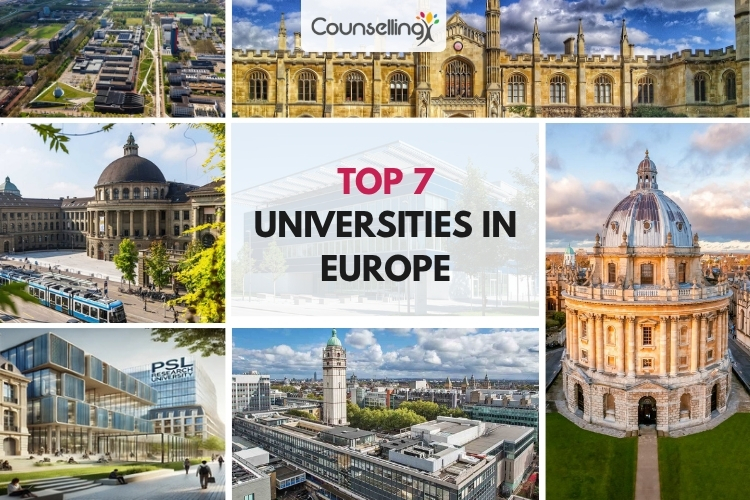
Which Are the 7 Best Universities in Europe?
Here are some of the top universities you can consider:
|
University |
QS World Ranking 2026 |
Country |
Popular Programs |
|
2 |
United Kingdom |
Engineering, Medicine, Data Science, Natural Sciences |
|
|
4 |
United Kingdom |
Philosophy, Politics & Economics (PPE), Medicine, Law, Computer Science |
|
|
6 |
United Kingdom |
Natural Sciences, Law, Mathematics, History |
|
|
ETH Zurich |
7 |
Switzerland |
Engineering, Computer Science, Architecture, Natural Sciences |
|
PSL Research University |
28 |
France |
Economics, Engineering, Cognitive Science, Life Sciences |
|
Technical University of Munich |
22 |
Germany |
Mechanical Engineering, Computer Science, Physics, Management |
|
Delft University of Technology |
47 |
Netherlands |
Architecture, Aerospace Engineering, Civil Engineering, Design |
1. Imperial College London
Imperial College London is situated in the heart of London with unparalleled access to research facilities, employers, and cultural sites. Its vibrant international community brings a truly global perspective, while strong industry connections open doors to exciting career opportunities. With pioneering research and high-impact alumni shaping science, engineering, and business, it’s a hub where ambition meets opportunity.
Who Gets In & How?
- Academic: High grades in relevant subjects; typical offers are A*AA in A-levels or equivalent.
- Entrance Exams: Some departments require admissions tests (e.g., BMAT for Medicine, STEP for Mathematics).
- English Language: IELTS: 6.5–7.0 overall, with minimum component scores.
- Application: UCAS application, including a personal statement and academic references.
What Will It Cost You?
- Tuition Fees: £35,100 - £42,000 per year for international students (most science and engineering; Medicine higher).
- Cost of Living: £1,400–£1,800 per month in London (accommodation, food, transport, and personal expenses).
Scholarships & Support You Can Claim
Imperial offers partial merit-based scholarships and strong departmental awards, which include President’s Undergraduate Scholarships and subject-specific funding.
2. University of Oxford
As one of the oldest universities in the English-speaking world, it boasts a deep alumni network of global leaders and Nobel laureates. Its collegiate system provides a close-knit community, unique academic mentorship, and holistic student support. Moreover, it has access to world-class libraries and research resources across all disciplines.
How to Secure Your Spot
- Academic: Top grades in A-levels, IB, or equivalent; subject prerequisites are standard.
- Entrance Exams: Subject-specific admissions tests (e.g., BMAT, LNAT, MAT).
- English Language: For English proficiency, you will need IELTS 7.5 overall, minimum 7.0 per component; TOEFL iBT 110 overall.
- Application: UCAS application, personal statement, and academic references.
Price of Studying Here:
- Tuition Fees: £35,260 to £59,260+ per year for international students, depending on program
- Cost of Living: £1,405 - £2,105 per month (£12,705–£17,595 per academic year)
3. University of Cambridge
With a rich heritage of transformative discoveries from Newton’s laws to the discovery of DNA, the University of Cambridge blends groundbreaking research with a supportive collegiate model that fosters both academic and social growth. Globally respected for teaching and research excellence, it inspires students with historic colleges, museums, and world-class facilities.
Rich academic heritage, including transformative discoveries like DNA structure and Newton’s laws.
What It Takes to Join:
- Academic: AAA at A-levels or comparable international qualifications; subject requirements crucial.
- Entrance Exams: Program-specific assessments (BMAT, LNAT, etc.); some courses may require written work.
- English Language: IELTS 7.5 overall (component minimums apply); TOEFL iBT 110 minimum.
- Application: UCAS plus Cambridge-specific supplement and interview.
How Much Will You Really Spend?
- Tuition Fees: £27,600–£70,554 per year, depending on your program.
- Cost of Living: £1,305–£1,655 per month or £11,100–£13,200 per year (university suggested range).
Scholarships & Resources You Can Benefit From
Notable awards include the Cambridge Trust Scholarships. Most colleges also offer their own grants and support schemes for international students.
4. ETH Zurich – Swiss Federal Institute of Technology
Renowned for research, teaching, and entrepreneurial innovation, this university has a vibrant international community with strong student support. Boasting world-class facilities and industry partnerships, especially in STEM, it has produced over 20 Nobel laureates, including Albert Einstein, alongside Fields Medalists, Pritzker Prize winners, and a Turing Award recipient.
Here’s What You’ll Need to Get in:
- Academic: Recognised secondary school-leaving certificate; certain countries require the ETH entrance exam/foundation year.
- Entrance Exams: Required for some international students (see ETH requirements).
- Language: Bachelor’s: German (C1 required); Master’s: mainly English (English B2–C1 or as per program).
- Application: Direct via the ETH Zurich online portal.
Price Check of Tuition & Daily Expenses
- Tuition Fees: CHF 730 per semester (CHF 1,460/year)
- Cost of Living: CHF 1500–CHF 2,800 per month
Scholarships, Grants & Help You Can Get
Excellent Master ’s-level scholarships (ESOP), plus limited undergraduate funding and government/Swiss external awards.
5. PSL Research University (Université PSL)
Offering strengths across sciences, engineering, humanities, and the arts, this research-intensive university encourages interdisciplinary collaboration. Located in the vibrant Latin Quarter, it connects students to cultural hubs and international research networks, including student exchange opportunities.
Checklist to Get Accepted:
- Academic: Excellent high school grades; individual department and program requirements.
- Language: French-taught (B2/C1 required) and select English-taught programs (IELTS/TOEFL as specified by department).
- Entrance Exams/Selection: Written application, sometimes interviews or additional written tests.
- Application: Via Parcoursup (for French students) or direct portal (for most international programs).
How Much Will Your University Life Cost?
- Tuition Fees: Around $3051 -$4181 per year. The fees may vary depending on your program.
- Cost of Living: €10,000 to €13,000 per year, depending on where you live.
Scholarships & Support You Can Get
University and departmental merit scholarships, French government scholarships (such as Eiffel), and international mobility grants are available.
6. Technical University of Munich (TUM)
Known for innovative research and strong industry partnerships with companies like BMW and Siemens, this Technical University of Munich attracts a multinational student body with courses in German and English. Its connections to Munich’s startup and entrepreneurial scene, along with a modern campus and state-of-the-art facilities, make it a hub for opportunity and innovation.
What You’ll Need to Get In
- Academic: Valid secondary diploma (may require Studienkolleg/foundation year if not recognised directly).
- Assessment: Program-specific aptitude test, written motivation statement, and sometimes interviews.
- Language: Most Bachelor’s are taught in German, and an increasing number of English Master’s programs.
- Application: TUMonline portal.
What Your Degree Will Really Cost
- Tuition Fees: typically ranging from €2,000 to €3,000 per semester for Bachelor's programs and €4,000 to €6,000 per semester for Master's programs.
- Cost of Living: €1,000–€2000 per month in Munich (accommodation + other costs).
Funding & Support Opportunities for You
TUM International Student Scholarships, DAAD, and private scholarships for high academic performers.
7. Delft University of Technology (TU Delft)
Renowned for engineering, design, and sustainability research, it combines project-based learning with close industry connections. Its large, innovative international campus community supports students while offering high employability, with many graduates joining top engineering and tech companies.
What It Takes to Join:
- Academic: Secondary school diploma with strong grades in mathematics, physics, and chemistry (as relevant to the program).
- Selection: Numerus fixus (fixed quota) for popular programs; selection may involve additional assignments/tests.
- Language: Bachelor’s English-taught: IELTS 6.5+ (no subscore below 6.0), TOEFL iBT 90+.
- Application: Studielink (Dutch system) plus TU Delft application portal.
How Much Will You Spend?
- Tuition Fees: €16,705 to over €18,876 annually for international bachelor's and master's studies.
- Cost of Living: €1,100–€1,600/month in Delft (as per university recommendation).
Financial Aid & Support You Can Tap Into
Excellence scholarships (Justus & Louise van Effen), Holland Scholarship, and other international awards.
Common Mistakes and How to Avoid Them
|
Mistake |
Description |
How to Avoid it |
|
Underestimating the Personal Statement |
Submit a generic or uninspired essay that doesn’t stand out. |
|
|
Missing Deadlines |
Late submissions are automatically rejected |
|
|
Ignoring Specific Requirements |
Missing course-specific prerequisites or tests |
|
|
Weak Academic Reference |
Generic recommendation with little insight. |
|
Final Words
The journey to studying in Europe is competitive. But you don't have to go through it alone. CounsellingX is your dedicated partner, providing the expert framework you need to succeed. We eliminate the guesswork and replace it with a proven strategy.
- Personalised University Shortlisting: We go beyond rankings to find the universities that are a perfect fit for your academic profile, career goals, and personal aspirations.
- Document Enhancement: Our expert counsellors, many of whom are alumni from these top universities, will work with you line-by-line to write powerful personal statements and application essays that get you noticed.
- Timeline and Deadline Management: We take the stress out of the process by managing your entire application calendar, ensuring every document and form is submitted flawlessly and on time.
- Interview Preparation: For universities like Oxford and Cambridge, the interview is make-or-break. We provide rigorous mock interview sessions and expert coaching to build your confidence and help you excel.
Ready to make Europe your dream study destination in 2026? Stop dreaming and start planning. Get expert guidance with CounsellingX for shortlisting, applications, and interview prep. Book your free consultation today and let us build your bridge to Europe.
FAQs
What is the modern university of the year 2026?
The Modern University of the Year 2026 title usually highlights institutions that excel in innovation, research impact, student experience, and employability. While specific awards vary, universities like TU Delft (Netherlands), ETH Zurich (Switzerland), and KU Leuven (Belgium) are frequently recognised for their modern teaching approaches, state-of-the-art facilities, and international outlook. CounsellingX can guide you in selecting a university that aligns with both modern rankings and your personal career ambitions.
What are the top 10 universities in the world in 2025?
Based on global rankings like QS World University Rankings and Times Higher Education, the top 10 universities in 2025 are:
- Massachusetts Institute of Technology (MIT), USA
- Stanford University, USA
- Harvard University, USA
- University of Cambridge, UK
- University of Oxford, UK
- California Institute of Technology (Caltech), USA
- Imperial College London, UK
- University of Chicago, USA
- ETH Zurich, Switzerland
- University College London (UCL), UK
What are the top 5 universities in Europe?
The top 5 universities in Europe, based on reputation, research, and global rankings, are:
- University of Oxford, UK
- University of Cambridge, UK
- ETH Zurich, Switzerland
- Imperial College London, UK
- University College London (UCL), UK
Do European universities require IELTS/TOEFL?
Yes, if the program is taught in English and you are not from a native English-speaking country, you will typically need to provide proof of English proficiency. Key points:
- Accepted tests usually include IELTS and TOEFL.
- Minimum scores vary by university and program.
- Some universities may accept alternative proof, like prior English-medium education.
CounsellingX can guide you on which test to take and the score requirements for each university.
How early should I start applying for 2026 admissions?
It’s best to start research and preparation in the spring or early summer of 2025. Steps include:
- Researching universities and programs.
- Preparing for English proficiency and other entrance tests.
- Drafting and refining personal statements and essays.
- Meeting early deadlines like October 15th for Oxbridge and other competitive programs.
Can students from India/UAE apply directly to these universities?
Yes, students from India, the UAE, and other countries can apply directly to European universities. However, it is important to carefully check the specific entry requirements, as they vary depending on your national curriculum, such as CBSE, ISC, or Tawjihiyya. Some universities may require completing a foundation year before starting the main program. Additionally, supporting documents like academic transcripts, test scores (e.g., IELTS/TOEFL), and recommendation letters are mandatory to complete the application.