Introduction
You sit down to study for exams, open your notes, and hours pass, and you’re not sure what you actually learned. And then you realise that the study habits that worked in high school are not enough.
As a student, it is important to develop effective time management and study techniques to truly understand, learn, and remember. Whether you're prepping for board exams, a competitive entrance test like SAT or ACT, or finals week in college, here you will learn some effective methods to study smartly for your exams and how to avoid distractions while studying.
Before You Open Your Book, Here is What You Need to Do
Before we discuss different studying methods, let's understand how you can set up the right environments even before you begin studying and why it's important.
- Get proper sleep: Science news research from 2019 says better sleep habits lead to better college grades. Staying up all night might look productive, but it doesn't really work. This tip is not just for the night before the exam.
- Eliminate Distractions: Try to cut down the background noise, as it can distract you while studying. Keep your phone on silent, close all tabs, and switch off the TV.
- Switch up your studying environment: Studying on the same desk at home can be boring after a few days. What you can try is checking out a quiet coffee spot or a library. Even a neuroscience news article says that switching your studying environment can increase your recall performance.
By following these tips, you can improve your concentration while studying and gradually build stronger analytical skills.
Effective Studying Methods for Your Upcoming Exams
Here are some of the effective tips that are backed by science:
The SQ3R Studying Technique
If you're someone who gets to the end of reading your textbook selection and has no idea what you’ve read, this technique is for you. It is designed to improve your comprehension and retention. Try this process to absorb the wall of text from your syllabus. This strategy includes these five steps”
- Survey: Instead of reading the entire book, just review the headings, bold texts, and diagrams
- Question: Make questions about the chapter's content, like what is in this chapter? What do I remember?
- Read: Now read the chapter and try to answer the questions you made before.
- Recite: When you are done with reading, summarise your own words and try recalling the major points.
- Review: Review everything, then quiz yourself on the questions, and reread when you need to.
Retrieval Practice
Retrieval practice helps you pull the information out of your memory instead of just looking for the answer in the textbook.
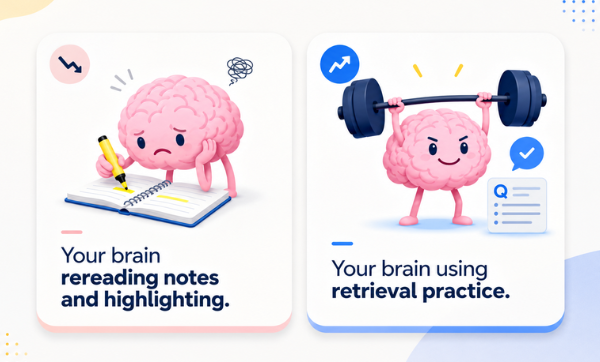
Re-reading notes feels productive because the information looks familiar. But, it's not effective as you forget this information when you close your book. Here are some effective ways to integrate this practice into your routine:
- Use practice tests or past papers without looking at your book or notes.
- Act as your teacher and think about what possible questions would be on a test.
- Create flashcards, but practice the retrieval technique.
This technique might look harder than re-reading, but it actually works.
Spaced Practice
To truly memorise your course material, you need to understand how your brain works. Your brain forgets things it hasn't needed in a while. This means when you try to cram everything into one night, you're basically fighting with your own brain.
Instead of one long session, in this technique, you revisit material at increasing intervals:
- Day 1: Learn the material in class.
- Day 2: Revisit and review.
- After one week: Revisit and review.
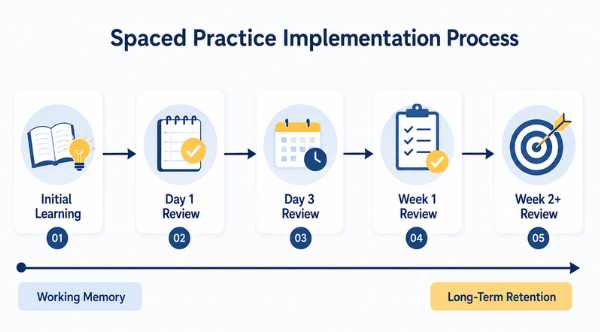
Every time you almost forget something and then recall it, that memory gets a little stronger and a little more permanent. This method encourages you to study over an extended period instead of trying to rote memorise before the exams.
PQ4R Method
If you are looking for an active approach to learning, PQ4R is one of the best methods to improve your memorisation. Here is how it works:
- Preview: Open your book or notes and thoroughly review the information you want to memorise; read only the headers and highlighted text.
- Question: Ask yourself questions related to the topic.
- Read: Read and try to answer your questions.
- Reflect: Check if your answers are correct. Go back if your answers are wrong.
- Recite: In your own words, summarise everything you have read.
- Review: Look over the information again.
Keep in mind, the more you practice and stay consistent with this method, the better the information will stay in your mind.
The Feynman Technique
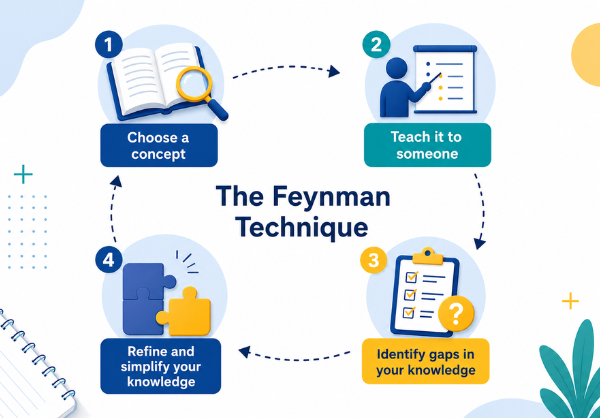
When you try to explain any information in simple and easy words, it sticks in your mind. This is Feynman's technique, in which you have to simply act as if you are explaining your topic to a 12-year-old student. This technique works for complex subjects like physics, economics, biology, etc.
Here's how it works:
- Write the topic or concept you are studying on any blank page.
- Explain it like you're teaching.
- Notice exactly where you get stuck and check where you were wrong.
- Go back, relearn, and try explaining it again.
Colour-Coded Notes
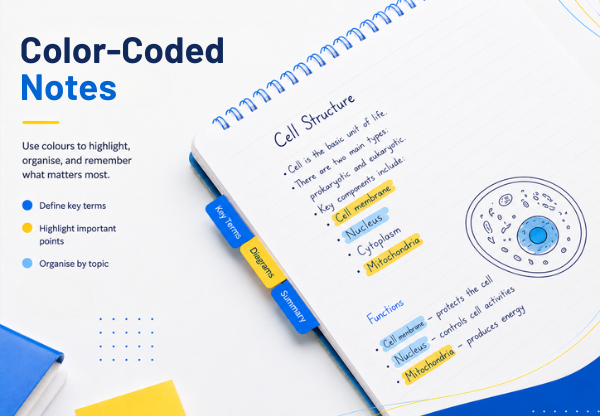
It's useless to make your notes if you can’t easily understand them later. Organising your notes can help you instantly spot definitions, formulas, or any critical point without rereading everything. According to a study from the National Library of Medicine in 2019, colour can improve your memory performance.
Simply assign colours with a purpose: red for must-know facts, yellow for supporting details, and a separate colour per topic. This isn't about making your notebook look pretty. It's about training your brain to instantly recognise importance at a glance during last-minute revision.
Mind Mapping
If you are a visual learner and looking at long paragraphs in textbooks spins your head, try mind mapping. It mirrors how your brain naturally organises information in the form of a diagram.
- Write your topic in the centre.
- Branch out with the main ideas.
- Add smaller branches for supporting details.
Instead of memorising facts, you're suddenly looking at one connected image. That's a much lighter mental load to carry into an exam hall.
How to Stop Procrastination While Studying
Now you actually know how to study smartly and avoid distraction, but what about procrastination? Most of the time, your brain will try to delay studying because it feels overwhelming and boring. Here is what will help you get rid of procrastination:
- Give yourself mini deadlines
Don't just say "I'll study for the exam." Say "By Tuesday at 6 pm, I'll have finished this chapter." Do this for a few days, and suddenly you've covered half your course material without the panic. By exam day, you're just revising your notes instead of learning everything. - Put your phone in another room
It's tempting to have a phone on your desk, but one buzz and you're suddenly deep in your Instagram feed instead of your notes. Simply turn it off, unless you're actually using your phone to study. - Take breaks
It might sound backwards for a procrastinator, right? But studying for hours straight just leads to burnout and information overload. That is why it's important to take short breaks between study sessions to help your brain actually absorb what you're learning.
Summing Up
Studying for exams doesn't mean stress, sleepless nights, and last-minute cramming. If you go blank even after studying for hours. The problem isn't your brain. It's your method. With the right study techniques for exams and a proactive approach, you can walk into your exam prepared and confident.
With the techniques above, you can avoid cramming the night before and make your study time more effective. Within a week, you’ll already notice a difference in how much you remember
FAQs
What is the best way to revise before exams?
- Practice past papers
- Use flashcards
- Focus on weak areas
- Do quick revision cycles instead of rereading everything
How do I stay focused while studying for long periods?
Use timed study blocks, remove your phone from the room, and take short breaks. A short walk works better than switching to social media, which can divert your attention for far longer than intended.
Is it better to study alone or in a group?
Solo study works well for reading and retrieval practice; group study is excellent for the Feynman technique, since explaining concepts to others and being questioned by them helps fill gaps fast.
How do I deal with exam anxiety?
Preparation is the biggest anxiety-reducer. Spaced practice and self-testing can help build genuine confidence, not just familiarity.
How to study effectively for exams in a short time?
Focus on high-impact techniques like active recall and past paper practice instead of rereading notes. Prioritise important topics, remove distractions, and study in short, focused sessions (25–50 minutes)
How many hours should I study for exams?
There’s no fixed number. 2–4 hours of focused study is often more effective than 8+ distracted hours. The key is concentration and quality, not just time spent.
How to study faster and remember more?
Use techniques like active recall, spaced repetition, and teaching what you learn. Avoid passive reading. The more your brain actively works to retrieve information, the faster and better you’ll remember it.