Introduction
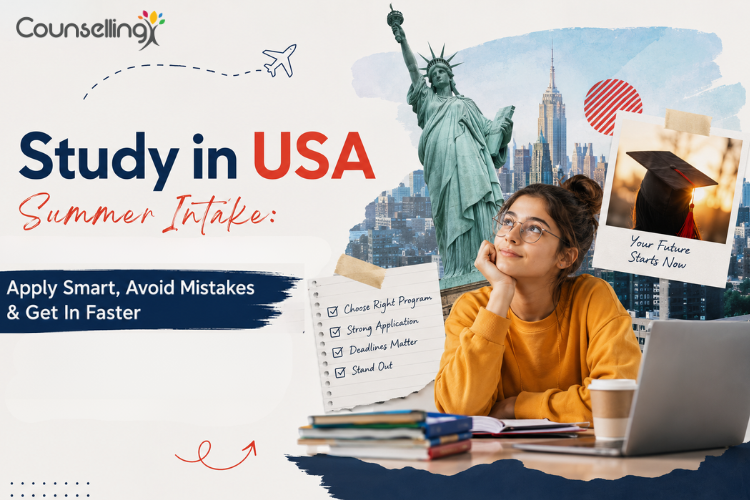
Are you an international student trying to get admission in the United States, but missed the fall or spring intake? What if I tell you, you don't have to wait for a year? Yes! It's possible.
Most students don't know this, but the USA offers a third admission window, Summer Intake. It usually starts from May or June. While the rest of the world is waiting for the next intake, you might already be packing your bags.
Less competition. Faster decisions. Same universities. Same degrees.
Wondering if the Summer Intake is the right choice for you? By the end of this blog, you will find out everything you need to know about Summer Intake, from application deadlines and top universities to the visa process and tuition costs. Lets delve in..
What Exactly Is Summer Intake and Is It Legit in USA?
Great question, because there's a lot of confusion around this.
The Summer Intake in the USA is one of three academic intakes offered by American universities. The other two are fall (August/September) and Spring (January). The summer intake usually starts in the month of May and runs through August. Due to its short window, fewer student apply which makes it easier to get in.
But the real question is, “Is it legit and valuable?” Absolutely.
From what I’ve seen, the summer intake can actually work in your favour as there is less competition, faster processing, and a chance to start your journey without waiting an entire year.
When Should You Start? The Application Timeline for Summer Intake in the USA
Here is a month-by-month overview to help you stay ahead of deadlines:
|
Month |
Key steps in the process |
|
June - August (previous year) |
Research universities and programs |
|
August - October |
Take GRE / GMAT / TOEFL / IELTS |
|
October - December |
Write SOP, gather transcripts, LORs and submit applications |
|
January - February |
Receive admission decisions and attend interviews |
|
February - March |
Accept admission, pay the deposit, and apply for an F-1 student visa. |
|
April - May |
Arrange accommodation & travel |
|
May - June |
Arrive in the USA and begin classes as per the program schedule. |
How Do You Actually Find Summer Intake Programs and Apply?
If you have decided to start your US education journey in the summer, here are some tips to find the summer programs and apply:
- Start with serious university research
Don't just find a list of "universities with summer intake". Visit each university's official admissions page, find your specific program, and confirm that it's open to international students in summer.
- Hunt for scholarships
Go to each university's financial aid page. Search "Global Summer Experience Scholarships".
- Take language tests
Register for TOEFL iBT or IELTS as early as possible. Scores take time, and most universities won't review your application without them.
- Submit applications
Go straight to university websites and follow their steps carefully. Most summer intake deadlines fall between February and March, so keep a close eye on those dates.
- Complete financial forms
Fill out any required financial declaration forms and get your bank statements.
- Request transcripts
Ask your previous institutions for a transcript. If any documents are in another language, get them officially translated and certified before submitting.
- Write essays
Write your personal essays. Don't rely on anyone, as you have to add your personal experience.
- Check requirements
Double-check that you have completed all parts of the application, including references if needed.
Which Documents Will You Need to Apply?
Documents you'll need are:
- Official academic transcripts (translated into English if necessary)
- Statement of Purpose (SOP)
- 2 to 3 Letters of Recommendation (LORs)
- Updated CV or Resume
- Valid passport copy
- Proof of English proficiency (IELTS or TOEFL score reports)
- GRE/GMAT score reports (for graduate programs)
- Bank statements for financial proof
- Valid passport copy
- Proof of English proficiency (IELTS or TOEFL score reports)
- GRE/GMAT score reports (for graduate programs)
- Bank statements for Financial proof
What's the Easiest Student Visa Process for the Summer Intake?
This is where most students mess up. They get their admission letter, celebrate, and then start the visa process three weeks before departure. Please don't do this. Here's how the student visa (F-1) process works for summer intake:
Step 1: Receive your I-20 from the university
Once accepted, your university will provide you with a Form I-20, which is your Certificate of Eligibility for Nonimmigrant Student Status.
Step 2: Pay the SEVIS Fee
Register on the SEVIS (Student and Exchange Visitor Information System) website and pay the required fee, which is currently $350 USD.
Step 3: Fill out the DS-160 application
The DS-160 is the official US non-immigrant visa application form, filled out online. Once submitted, you'll receive a confirmation page you'll need for your embassy appointment.
Step 4: Pay the Visa Application Fee
This is approximately $185 USD and must be paid through the official US Embassy portal for your country.
Step 5: Book Your Embassy Interview
Schedule your visa interview at the nearest US Embassy or Consulate
Step 6: Attend the Visa Interview
Bring your I-20, DS-160 confirmation, SEVIS fee receipt, passport, admission letter, academic documents, and financial proof. Be clear and honest. Show that you plan to return home after your studies.
How Much Will It Cost? Estimated Tuition Fees for Summer Intake in USA
For summer intake specifically, since you're often enrolling in one semester rather than a full year, your tuition cost is calculated per credit hour. Graduate programs at mid-tier universities typically charge $1,000 – $2,500 per credit hour, and a summer semester might require 9–12 credits.
Which Universities Should You Be Looking At? Top Universities Offering Summer Intake in USA
Here are some well-known institutions that offer summer sessions and accept international students:
- Virginia Tech Language and Culture Institute
- University of Illinois Chicago
- Rochester Institute of Technology
- Arizona State University
- University of Utah
- University of Alabama at Birmingham
- Oregon State University
- Colorado State University
- The University of Alabama
- Florida Atlantic University
- Georgia State University
- Oklahoma State University, Stillwater
- Mississippi State University
- Illinois State University
- Texas State University
- Southern Illinois University, Carbondale
What Can You Actually Study? Popular Programs Available
Here's what international students most commonly pursue during summer intake:
Graduate Programs (Master's level):
- Computer Science / Artificial Intelligence / Machine Learning
- Data Science and Analytics
- Electrical and Computer Engineering
- Business Administration
- Public Health and Healthcare Management
- Information Technology
- Finance and Financial Engineering
Undergraduate Programs:
- Transfer credits and prerequisite courses
- Liberal Arts and Sciences
- Business Administration
Certificate and Short-Term Programs:
- English Language Programs (academic preparation)
- Project Management
- Digital Marketing
- Data Analytics
- Cybersecurity Fundamentals
Mistakes That Can Affect Your Application And How to Avoid Them
Mistake 1: Assuming All Universities Offer Summer Intake
They don't. Always verify on the official university website. Many students build entire application plans around universities that don't accept international students in the summer.
Mistake 2: Delaying Standardised Tests
If you need a GRE, GMAT, TOEFL, or IELTS, you need proof before you apply. These tests have registration waitlists, and rescheduling adds weeks. Take your tests early.
Mistake 3: Writing a Generic SOP
Your Statement of Purpose is like you are speaking directly to the admission committee. So, avoid making it sound vague and clichés. Admissions committees want to hear your voice, so be specific and genuine.
Mistake 4: Ignoring Scholarship Opportunities
Yes, scholarship options are fewer in the summer, but they exist. NYU offers summer scholarships. CIEE offers grants. Many universities have university-level merit aid.
Mistake 5: Starting the Visa Process Late
Visa appointment slots fill up fast. Embassy queues can run 8 - 12 weeks. If you get your I-20 in February and try to book a visa appointment for April, you may have a problem. Apply as early as possible.
Mistake 6: Not Confirming Financial Documents
US embassies look closely at your financial proof. You need to demonstrate that you can cover tuition and living expenses for at least your first year. Bank statements, sponsor letters, and financial proof need to be consistent.
Thinking About Summer Intake? Here's Your Next Step
You've made it through the entire guide, which tells me you're serious about this. And serious deserves support. You have got the information, but handling it all alone, where most students either make costly mistakes or simply give up. The wrong university selection, a weak SOP, a missed visa deadline, any one of these can set you back a full year.
That's exactly why CounsellingX exists.
Our expert counsellors have helped hundreds of students secure admissions in the USA, even with summer intake. Our counsellors know which universities are the right option for you, what your profile realistically qualifies for, and how to put together an application that actually gets noticed.
Whether you're just thinking about it or you've already begun the process and feel stuck, we're here to handle your application process.
FAQs
Q: Is summer intake in USA for full degree programs or only short courses?
Both. Some universities offer full-degree Master's and Bachelor's programs with summer start dates, while others offer prerequisite courses, certificate programs, and academic pathway programs. It depends entirely on the university and program.
Q: Which is better, Fall intake or Summer intake in USA?
The fall intake has more program choices, larger scholarship pools, and is more widely recognised. Summer intake has lower competition, faster admissions, and suits students who missed Fall deadlines or want to begin sooner.
Q: Can I apply for the summer intake in USA without the GRE?
Many universities have become test-optional, especially post-pandemic. However, a GRE score can still strengthen your application significantly. Check each university's specific requirements for the program you're targeting.
Q: Is it harder to get a US student visa for summer intake?
The visa process itself is the same regardless of intake. However, summer is technically less peak season, which means slightly shorter appointment waits.
Q: What is the SEVIS fee, and do I need to pay it for summer intake?
Yes. All international students applying for an F-1 student visa must pay the SEVIS fee of $350 USD. This applies to all intakes, including summer.