Key Takeaways
Thinking about studying engineering in Canada? Here you can explore the top schools you should know for 2026 and what sets them apart. From unique programs to opportunities beyond the classroom, you’ll get a glimpse of what makes each university stand out. By the end, you’ll have the insights you need to start planning your next move, with subtle support from experts along the way.
Introduction
Looking to study engineering in Canada in 2026? You’ve got questions, and we’ve got answers. From the top programs to what makes each school unique, this guide is your shortcut to making an informed choice. That single decision influences the skills you build, the opportunities you see, and how far your degree can take you. For students with global goals, Canada has become one of the most important places to start.
With world-class engineering programs, strong industry connections, and clear post-study pathways, Canada offers real advantages. Whether you are aiming for software engineering in Toronto or petroleum engineering in Alberta, this guide breaks down the top engineering universities in Canada for 2026 and the decisions that matter most. CounsellingX supports students with the clarity and direction needed to navigate this journey.
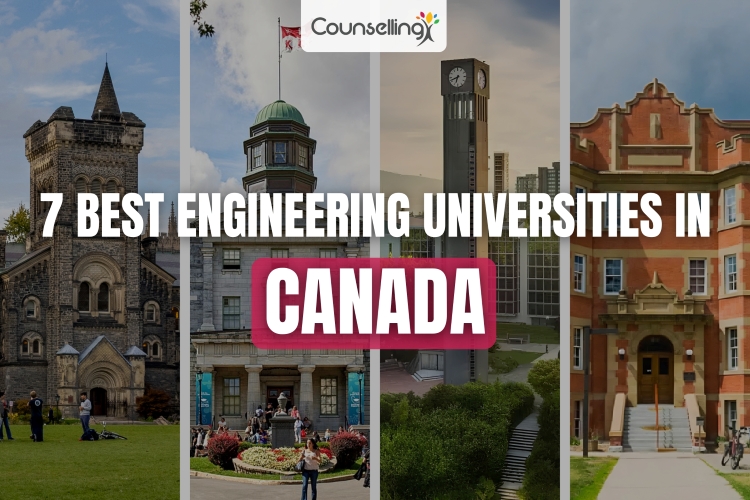
Which are the Top 7 Engineering Schools in Canada for 2026
Below is our selection of the premier engineering institutions in Canada. This table provides a snapshot of their standing and location.
|
QS Ranking 2026 |
University |
Location |
Key Strengths |
|
1 |
University of Toronto |
Toronto, ON |
Research output, AI leadership, industry connections |
|
2 |
University of British Columbia (UBC) |
Vancouver, BC |
Sustainability focus, stunning campus, global partnerships |
|
3 |
Waterloo, ON |
World’s largest co-op program, entrepreneurship, and software engineering |
|
|
4 |
McGill University |
Montreal, QC |
Prestige, medical & bioengineering, vibrant student life |
|
5 |
Edmonton, AB |
Energy systems, nanotechnology, AI research (DeepMind) |
|
|
6 |
Université de Montréal (Polytechnique Montréal) |
Montreal, QC |
Francophone excellence, aerospace, strong industry ties |
|
7 |
University of Calgary |
Calgary, AB |
Energy innovation, entrepreneurial focus, strong industry funding |
1. University of Toronto (U of T)
The University of Toronto is Canada’s top-ranked institution and a global heavyweight in research. Its Faculty of Applied Science & Engineering is renowned for pioneering work in artificial intelligence and machine learning.
- Innovation Hub: Home to the Vector Institute for Artificial Intelligence, attracting top talent worldwide.
- PEY Co-op: The Professional Experience Year (PEY) Co-op program allows students to work for 12 to 16 months, gaining significant industry experience before graduation.
- Diverse Community: Located in one of the most multicultural cities in the world, offering a rich student experience.
Popular Engineering Programs Offered for You:
- Engineering Science (highly selective)
- Computer Engineering
- Mechanical Engineering
- Civil Engineering
- Chemical Engineering
What It Takes to Join:
- GPA: Highly competitive; successful applicants usually have an A average (90%+) in prerequisite subjects (Math, Chemistry, Physics).
- Standardised Tests: SAT/ACT are generally not required unless you are applying from a US-curriculum school.
- English Proficiency: IELTS (minimum 6.5, no band below 6.0) or TOEFL (minimum 100).
- Supplemental Application: Includes a mandatory video interview and a written response to assess problem-solving skills.
What It Costs to Study Here:
- Tuition: $65,000 - $70,000 CAD per year
- Living Costs: $20,000 - $25,000 CAD per year
Internship Opportunities you can expect:
The PEY Co-op is the flagship program, with students earning an average salary of $50,000+ CAD during their placement year.
2. University of British Columbia (UBC)
Located on the stunning west coast, UBC combines academic rigour with a commitment to sustainability and global citizenship.
- Sustainability Leadership: UBC is a global leader in climate action and sustainable engineering practices.
- Entrepreneurship: The "entrepreneurship@UBC" program helps students launch startups and commercialise research.
- Campus Life: Consistently ranked as one of the most beautiful campuses in the world, with access to beaches and mountains.
Top Engineering Fields for you
- Civil Engineering
- Electrical and Computer Engineering
- Environmental Engineering
- Biomedical Engineering
- Mining Engineering
What You’ll Need to Get In
- GPA: rigorous admission standards; typically requires high A grades in senior-year math and science courses.
- Standardised Tests: Not typically required for students outside the US curriculum.
- English Proficiency: IELTS (6.5 overall, 6.0 minimum per band) or TOEFL (90 overall).
- Personal Profile: A crucial part of the application where students answer short essay questions about their experiences and challenges.
How Much Will You Spend as a Student?
- Tuition: $58,000 - $62,000 CAD per year
- Living Costs: $22,000 - $28,000 CAD per year (Vancouver is known for high housing costs).
Research and Industry Experience You Can Gain:
UBC Engineering Co-op places students in over 4,500 jobs annually across Canada and internationally.
3. University of Waterloo
Waterloo is synonymous with engineering in Canada. It is the engine behind the "Tech Triangle" and a feeder school for Silicon Valley giants.
- Co-op Excellence: Operates the largest post-secondary co-operative education program in the world. Students graduate with up to two years of paid work experience.
- Intellectual Property Policy: Waterloo has a "creator-owned" IP policy, meaning if you invent something on campus, you own it. This fosters a massive startup culture.
- Silicon Valley Pipeline: Frequently cited as one of the top recruitment universities for Google, Apple, and Facebook.
Engineering Majors, You Can Choose From
- Software Engineering
- Mechatronics Engineering
- Systems Design Engineering
- Nanotechnology Engineering
- Biomedical Engineering
What You’ll Need to Get In:
- GPA: Extremely competitive. Admission averages for top programs like Software Engineering often exceed 95%.
- Admission Information Form (AIF): Mandatory for all engineering applicants. It highlights extracurriculars and programming experience.
- English Proficiency: IELTS (6.5) or TOEFL (90).
- Contests: Participation in math (Euclid) and computing (CCC) contests is highly recommended and boosts admission chances.
Total cost of Your Studies:
- Tuition: $66,000 - $72,000 CAD per year
- Living Costs: $18,000 - $22,000 CAD per year
Real-World Experience Through Internships you can get:
100% of engineering students participate in co-op. The "Velocity" incubator is Canada’s most productive startup incubator.
4. McGill University
Located in vibrant Montreal, McGill is one of Canada's oldest and most prestigious universities, known for its rigorous academics and international reputation.
- Global Brand: Known as the "Harvard of Canada," McGill carries significant weight with employers worldwide.
- Research Intensity: A member of the U15 Group of Canadian Research Universities, with heavy investment in bioengineering and materials science.
- Cultural Hub: Montreal is consistently ranked as the best student city in North America, offering affordable living and a rich cultural scene.
Engineering Programs You Can Study:
- Bioengineering
- Mechanical Engineering
- Electrical Engineering
- Materials Engineering
- Software Engineering
Checklist to Get Accepted:
- GPA: Admission is based strictly on grades (R-Score for Quebec students, A-Level/GPA for others). Averages required are very high (often A/A* equivalent).
- Standardised Tests: SAT/ACT required for students from US high school systems.
- English Proficiency: IELTS (6.5) or TOEFL (90). Note: Some programs may exempt students if their previous education was in English.
What It Costs to Study Here:
- Tuition: $55,000 - $65,000 CAD per year (varies significantly by program).
- Living Costs: $16,000 - $20,000 CAD per year (Montreal is relatively affordable).
Hands-On Experience you will gain:
The Engineering Internship Program (EIP) offers placements of 4, 8, 12, or 16 months. The Summer Undergraduate Research in Engineering (SURE) program is excellent for research experience.
5. University of Alberta
Located in Edmonton, U of A is a powerhouse for energy and resource engineering, but has also pivoted to become a world leader in Artificial Intelligence.
- AI Leadership: Home to AMII (Alberta Machine Intelligence Institute), a top global AI research centre. DeepMind opened its first international lab here.
- Energy Focus: World-renowned for petroleum and chemical engineering, closely tied to Alberta's energy sector.
- State-of-the-Art Facilities: The National Institute for Nanotechnology is located on campus.
Engineering Majors, You Can Choose From:
- Petroleum Engineering
- Chemical Engineering
- Mechanical Engineering
- Computer Engineering (Software Option)
- Engineering Physics
What the University Expect from Applicants:
- GPA: Competitive admission based on five key high school subjects.
- English Proficiency: IELTS (6.5) or TOEFL (90).
- Standardised Tests: Not generally required for non-US curricula.
How Much Will You Spend as a Student?
- Tuition: $42,000 - $48,000 CAD per year
- Living Costs: $15,000 - $19,000 CAD per year
Industry Internships and Research Programs for you:
The Co-op program places students in over 1,400 companies. The university's strong ties to the energy sector provide unique placement opportunities.
6. Université de Montréal (Polytechnique Montréal)
Polytechnique Montréal is the engineering school affiliated with the Université de Montréal. It is a premier institution for research and innovation, particularly in aerospace.
- Aerospace Hub: Montreal is one of the world's aerospace capitals, and Polytechnique has deep ties with Bombardier, CAE, and Pratt & Whitney.
- Research Volume: It conducts some of the most intensive engineering research in Canada.
- Language: While primarily Francophone, many graduate programs and research opportunities are accessible to English speakers, and it offers a truly bilingual environment.
Engineering Programs You Can Study:
- Aerospace Engineering
- Biomedical Engineering
- Chemical Engineering
- Computer Engineering
What You Need to Get In:
- Language: Proficiency in French is typically required for undergraduate programs (TFI or DALF). However, resources exist for non-native speakers.
- GPA: Strong academic record in math and science.
- Prerequisites: Specific courses in calculus, chemistry, and physics are mandatory.
What Students Typically Spend Each Year
- Tuition: $30,000 - $35,000 CAD per year (one of the most affordable options for top-tier engineering).
- Living Costs: $16,000 - $20,000 CAD per year.
Real-World Experience you will gain:
Mandatory internships ensure all graduates have practical experience.
7. University of Calgary
The Schulich School of Engineering at U of Calgary is known for its entrepreneurial spirit and strong industry funding.
- Engineering Leadership: The school focuses on developing leadership skills alongside technical ability.
- Digital Innovation: A heavy focus on integrating digital skills into all engineering disciplines.
- Funding: Consistently ranks high for research funding per student.
Popular Engineering Disciplines Offered for You:
- Energy Engineering
- Geomatics Engineering
- Software Engineering
- Biomedical Engineering
Admission Requirements you'll need to fulfil:
- GPA: Competitive average calculated on five required courses.
- English Proficiency: IELTS (6.5) or TOEFL (86).
- Mathematics: Strong emphasis on high-level high school calculus.
Estimated Tuition fee you need to pay:
- Tuition: $35,000 - $40,000 CAD per year
- Living Costs: $16,000 - $20,000 CAD per year
Internship & Research Opportunities:
The Engineering Internship Program offers 12-16-month paid placements.
What Top Engineering Schools Look for in Applicants
Canadian engineering schools are academically rigorous. While they may not use the "holistic" approach as aggressively as US Ivy Leagues, they still look for specific traits:
- Academic Excellence: This is the most critical factor. High grades in Mathematics (Calculus/Vectors), Physics, Chemistry, and English are non-negotiable. Aim for 90%+ for top-tier programs.
- Strong STEM Foundation: Participation in math contests (like Waterloo’s Euclid) or science fairs demonstrates a genuine aptitude for engineering.
- Communication Skills: Engineering is a team sport. Schools like Waterloo and U of T use video interviews to assess your ability to communicate ideas clearly.
- Programming Experience: For software and computer engineering tracks, prior knowledge of Python, Java, or C++ is a significant asset.
- English Proficiency: Meeting the minimum isn't enough; a high score ensures you can handle complex technical lectures in English.
Scholarships & Financial Aid Options
While international students are not eligible for Canadian government loans, there are substantial scholarship opportunities:
- Entrance Scholarships: Most universities automatically consider applicants for merit-based awards (ranging from $1,000 to $10,000) based on high school grades.
- Major International Awards:
- Lester B. Pearson Scholarship (U of T): Full ride (tuition + living).
- International Major Entrance Scholarship (UBC): Up to $80,000 CAD over 4 years.
- President's International Distinction Scholarship (University of Alberta): Up to $120,000 CAD.
- Co-op Earnings: This is a major financial aid tool. Students at Waterloo or U of T can earn $40,000 - $80,000 CAD spread over their degree through co-op terms, significantly offsetting costs.
Common Mistakes International Students Make
Here are some of the common mistakes you can make:
- Ignoring Prerequisites: Canadian engineering programs have very specific course requirements (e.g., Calculus, Vectors, Chemistry, Physics). Missing one can lead to rejection.
- Underestimating the Visa Process: Study permits can take months to process. Apply as soon as you receive your acceptance letter.
- Focusing Only on Rankings: A co-op-focused school like Waterloo is very different from a research-focused one like McGill.
- Missing Supplemental Deadlines: Many students submit the main application but forget the separate deadline for video interviews or portfolios.
- Not Budgeting for Winter: If you are coming from a warm climate, budgeting for proper winter gear ($500+) is a real necessity.
Conclusion
Applying to engineering schools involves moving parts: strict grade requirements, confusing prerequisites, and high-stakes visa applications. CounsellingX simplifies this journey.
Our expert counsellors include graduates from top Canadian universities who understand the system from the inside out. We provide:
- Strategic Shortlisting: Matching your grades and career goals with the right Canadian universities.
- Document Review: Ensuring your transcripts and course descriptions meet Canadian standards.
- Interview Coaching: preparing you for the video interviews required by top schools like U of T and Waterloo.
- Visa Guidance: helping you simplify the study permit process to ensure you arrive on time.
Don't navigate this complex process alone. Ready to start your engineering career in Canada? Book a session with CounsellingX today to ensure your application stands out from the crowd.
FAQs
What are the best engineering schools in Canada for 2026?
The University of Toronto, University of British Columbia (UBC), and University of Waterloo consistently rank as the top three for engineering in Canada.
Which Canadian engineering universities are best for international students?
The University of Toronto and McGill are excellent for their diverse international communities. Waterloo is top-tier for students seeking work experience through co-op.
Do top Canadian engineering schools require GRE or SAT?
Generally, no. SAT/ACT is usually only required if you are studying in a US-curriculum high school. GRE is for graduate programs and is also often optional in Canada.
What is the average cost of studying engineering in Canada?
International tuition ranges from $35,000 to $70,000 CAD per year. Living costs add another $15,000 to $25,000 CAD.
Are scholarships available for international engineering students?
Yes, merit-based entrance scholarships are common. Major awards like the Lester B. Pearson (U of T) are highly competitive but cover full costs.
What are the top 5 engineering schools in Canada?
- University of Toronto
- University of British Columbia
- University of Waterloo
- McGill University
- University of Alberta
Which Canadian engineering school has the highest acceptance rate?
Schools like the University of Calgary or the University of Alberta generally have slightly higher acceptance rates compared to the ultra-competitive programs at Waterloo or U of T, though they remain selective.
Which engineering disciplines are most in demand in Canada?
Software Engineering, Civil Engineering, and Environmental Engineering are in very high demand due to Canada's tech boom and infrastructure needs.